
Episode 236 · 2024-02-07 · 53:19 · Original in Finnish
Quality Investing with Sifter | Santeri Korpinen | Neuvottelija 236
Originally published as “Laatuyhtiöillä ylituottoja Sifter | Santeri Korpinen | Neuvottelija 236”
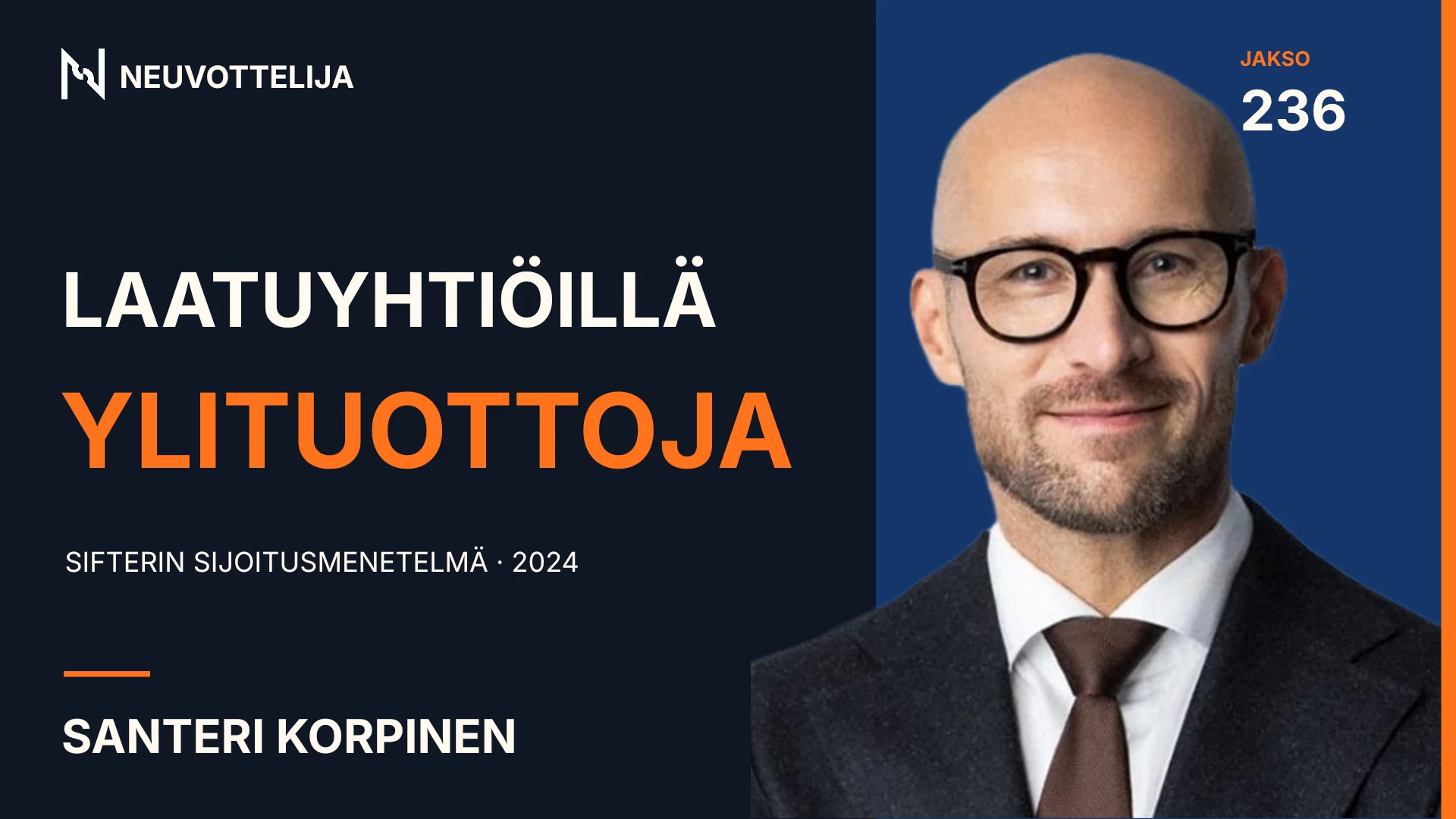
Santeri Korpinen, CEO of Sifter Capital, explains quality investing through competitive advantages, returns on capital, a five-year horizon and investment-team discipline. Examples include Microsoft, Novo Nordisk and Costco. Published on 7 February 2024 in commercial collaboration with Sifter Capital.
Core theses
- Korpinen describes business-model research as the foundation for interpreting financial measures.
- A five-year horizon guides Sifter’s assessment of valuation, competitive position and portfolio changes.
- Management and ownership structures influence whether a profitable business creates lasting shareholder value.
- The team’s culture and discipline are central to how Korpinen describes the investment process.
Watch and listen
Key moments
- 00:00 — Santeri Korpinen and commercial collaboration with Sifter
- 00:17 — One fund and a focused investment process
- 00:43 — 2023 returns and international investing
- 02:19 — What is quality investing?
- 03:50 — Quality, valuation and the long term
- 04:20 — Analyst forecasts and independent research
- 05:30 — Sifter’s research process and understanding the business model
- 07:20 — Margins, returns on capital and pricing power
- 09:05 — Long holding periods and company management
- 10:24 — Novo Nordisk: quality and growth
- 11:43 — Market potential and competitive position
- 12:39 — Profitable growth and the business life cycle
- 14:07 — The core business, acquisitions and capital discipline
- 15:17 — Leadership risk and enduring corporate culture
- 17:13 — Owners, Japan and China
- 18:33 — Cash and capital allocation in Japanese companies
- 20:00 — Low valuations and the risk of a value trap
- 20:52 — Lean thinking in the investment process
- 22:13 — Microsoft, Copilot and new growth
- 25:16 — Huhtamäki, KONE and Atlas Copco
- 26:48 — Cyclicality and predictability
- 28:34 — Macro trends and bottom-up analysis
- 30:41 — When to sell and how portfolio companies are ranked
- 32:30 — Long–short strategies and avoiding complexity
- 33:20 — Currencies, headquarters and global business
- 34:50 — Emerging markets and political risk
- 36:15 — The 2022 market decline and adding to holdings
- 37:25 — Fees, alpha, beta and the Sharpe ratio
- 40:05 — Investor psychology and learning from mistakes
- 42:00 — Sifter’s culture and continuity of the method
- 43:10 — Discipline in difficult markets
- 44:32 — Costco’s membership business model
- 49:14 — Terho Puustinen and Hannes Kulvik’s investment thinking
- 50:50 — Liquidity, assets under management and team efficiency
- 53:01 — Insider 43: The Call of History
Commercial collaboration: Sifter Capital. This article is based on Neuvottelija 236, published on 7 February 2024. Assessments of companies, portfolio holdings and markets reflect the interview at that time.
How does an investor recognise a quality business, and what is a reasonable price to pay for it? Santeri Korpinen, CEO of Sifter Capital, explains to Sami Miettinen a research process built around business models, competitive advantages and returns on capital. The central question is why a business should remain successful five years into the future.
The interview opens with returns for 2023. Korpinen reports a 31% return for Sifter, consistent with the fund’s own annual report for its R/I share class. The original YouTube chapter list incorrectly labels this comparison as 2022: the speakers are discussing the previous year in a February 2024 interview. Their opening comparison with the Helsinki stock market does not establish the global fund’s risk-adjusted outperformance. (00:30, Sifter’s 2023 annual report)
Understanding what produces the numbers
Korpinen describes an initial screen of historical financial measures. Growth, margins and returns on capital help identify businesses worth examining. Research then turns to the reasons behind those results: what gives the company an advantage, and why should customers continue buying from it? (05:31)
The team develops its own hypothesis before comparing it with outside analysts’ views. Korpinen sees this sequence as a way to reduce the influence of an established market narrative. He estimates that numerical analysis accounts for less than a fifth of the team’s work. The emphasis is on understanding the business sufficiently well to judge whether its earnings can endure. (05:55, 07:56)
The five-year horizon also shapes valuation. Korpinen argues that a strong company can appear expensive on near-term earnings while subsequent earnings growth makes the purchase price look reasonable. That remains an investment hypothesis: growth can disappoint, and a sound business does not make its future share price certain. (03:49)
Novo Nordisk and the value of future growth
Novo Nordisk illustrates how an established business can contain additional growth opportunities. Korpinen says Sifter originally invested on the strength of its diabetes business. The team recognised the potential of obesity treatments, but he says it initially assigned no value to that opportunity in its investment case. (10:24)
Sifter looks for businesses with an existing record of making money. A strong position in a narrow market can be attractive when challenging the incumbent would be costly. The quality of growth depends on the resources required to achieve it and the company’s ability to defend its position. (11:32, 12:33)
Capital allocation follows the same logic. Korpinen is sceptical of acquisitions that take a slowing business far beyond its own expertise. He prefers investment that strengthens the existing business, distribution and customer value. Strong cash generation makes management’s decisions about the use of that cash especially consequential. (13:44)
Leadership, ownership and institutional habits
Korpinen favours executives who build an organisation that can prosper under their successors. Dependence on a celebrated individual introduces risk even when that leader has previously delivered results. Ownership structures raise a related question: whose interests influence decisions, and what position does a small outside shareholder occupy? (15:16, 17:17)
The discussion of Japan connects low valuations and large cash balances with the use of capital. Attractive multiples require further investigation into corporate structures, decision-making and the prospects of shareholders benefiting from the business’s success. A valuation screen is the start of that inquiry. (18:33)
Microsoft and the work of long-term ownership
Korpinen says Sifter had owned Microsoft for 13 years at the time of the interview. He describes the development of its cloud business and considers Copilot as a potential new revenue stream. Miettinen adds his experience as a user: in early 2024, language support and cost constrained its usefulness in his Finnish workplace. The exchange brings a customer’s practical assessment into the investor’s growth discussion. (22:10)
Long holding periods require continuing scrutiny. Korpinen describes a portfolio of roughly 30 companies ranked against one another on expected five-year returns and risks. A rising share price can reduce the prospective return. A weakening competitive position can also justify selling: he cites Sifter’s exit from Intel around the turn of 2018–2019. (30:46)
He connects the 2023 return to decisions made during the 2022 market decline. Sifter added to businesses whose longer-term prospects it still considered strong. The example shows the emotional demands of the approach: investors must tolerate falling prices while recognising that their assessment of the underlying business may itself be wrong. (36:13)
Costco makes the business model tangible
Costco provides the interview’s most concrete discussion of how a company earns money. Korpinen examines the relationship between membership fees, inexpensive goods and customer loyalty. Membership must deliver enough value for customers to keep shopping and renewing. Pricing decisions therefore affect the durability of the entire model. (44:39)
The example brings the conversation back to corporate culture. An opportunity to charge customers more in the short term can conflict with maintaining a valuable long-term relationship. In Korpinen’s account, assessing quality includes understanding how management resolves those choices. (47:48)
Discipline inside the investment team
Korpinen considers investor psychology a major risk. He describes the team as a way to manage uncertainty, review mistakes and maintain the agreed strategy. A process earns credibility through how it is followed when market conditions make that difficult. (39:58, 43:13)
The interview presents Sifter’s own investment thinking in February 2024. Historical returns and interview assessments do not guarantee future performance. Anyone using the discussion to inform an investment decision needs to assess the fund’s current terms and risks separately.
Watch Neuvottelija 236 or read the timecoded Finnish transcript. The related Insider 43: The Call of History is a Finnish-language YouTube members-only episode recorded during the same visit. Its subject is introduced at the end of the main episode; this article covers the public interview.
Go deeper
People and topics
Guests: Santeri Korpinen